

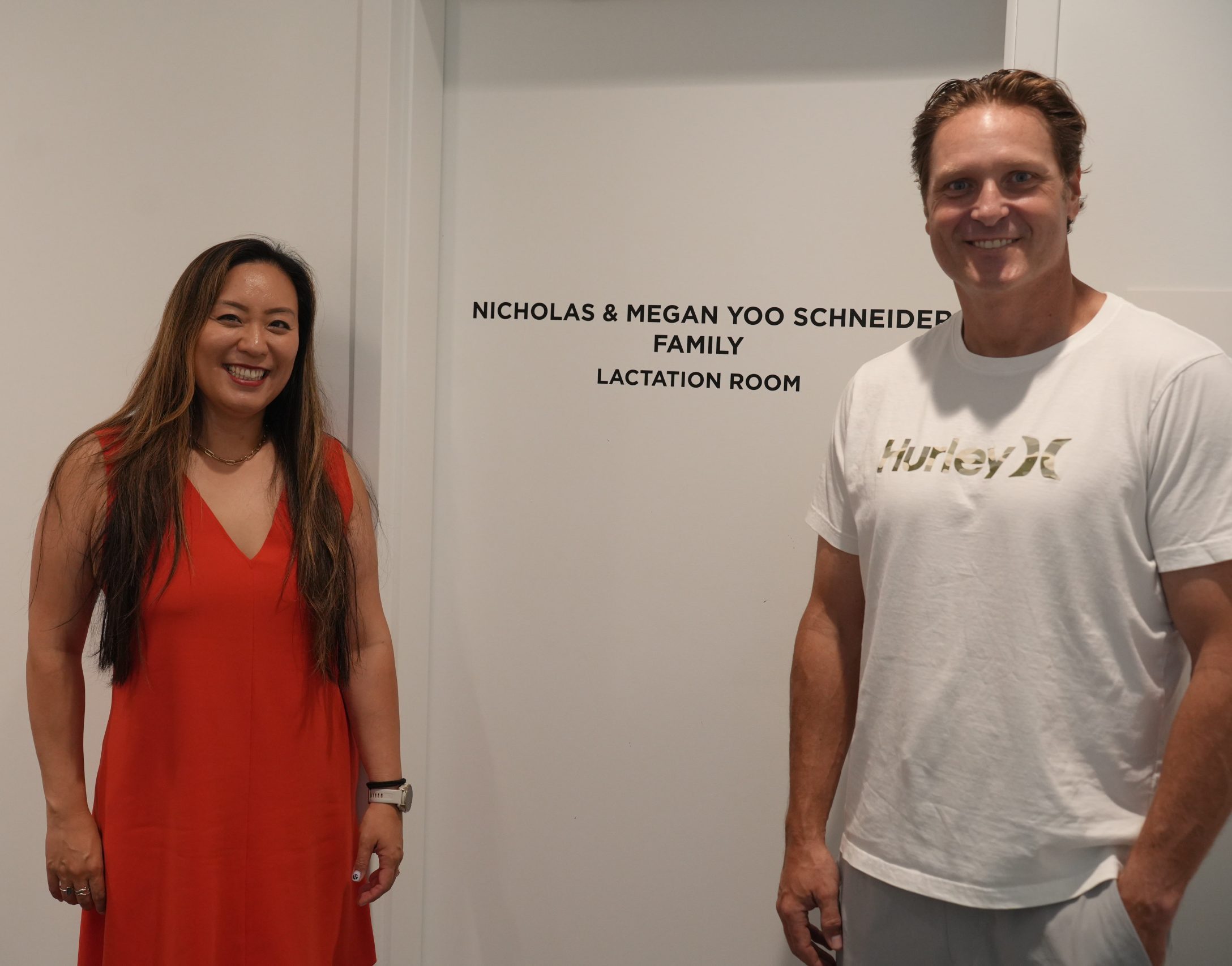
Megan Yoo Schneider (B.S. ’12, M.S. ’14) knows that success in graduate school rarely happens in isolation. As a two-time UC Irvine engineering alumna, executive leader at Accenture, and member of the Graduate Division Dean’s Leadership Council, she has experienced firsthand the importance of community, mentorship and perseverance. Recently, she and her husband, Nicholas, named the lactation room at the Verano 8 Community Center, creating a welcoming space for graduate student parents.
UCI Graduate Division spoke with Megan about her unconventional path to UC Irvine, what inspired her gift, and why supporting graduate students means supporting their families as well.
Your journey to UC Irvine wasn’t exactly traditional. What led you here, and what was your experience like?
My path to UC Irvine was definitely unconventional.
Growing up in Irvine, I assumed I would leave California for college. My high school had encouraged me to apply early to Harvard, and that was the direction everyone expected me to take. But during my senior year, my family experienced significant trauma. My grades dropped, and when Harvard asked what had happened, I didn’t have the language to explain it. I simply sent them poetry. Needless to say, I wasn’t admitted.
I received a full scholarship to Tulane University to study environmental engineering, but before classes even began, Hurricane Katrina changed everything. The university eliminated my major, and shortly afterward I learned they were restructuring their engineering program. I realized it wasn’t the right fit for me.
I transferred to USC, but despite being promised financial support, the scholarship didn’t fully materialize. I simply couldn’t afford to stay. I remember collections calling me every week, and eventually I had to leave school and begin working full time.
After a couple of years, I transferred to UC Irvine.
By then, I understood exactly what education meant to me because I had fought so hard to get there. I worked throughout school, carefully planned my finances, found internships, and earned scholarships through professional organizations. I’m incredibly grateful that I graduated debt-free.
Even when I returned to earn my master’s degree, I approached it with the same mindset. I worked full time during the day, took evening classes, and structured my coursework around my employer’s tuition reimbursement program. It wasn’t always easy, but UC Irvine gave me the flexibility to make it work.
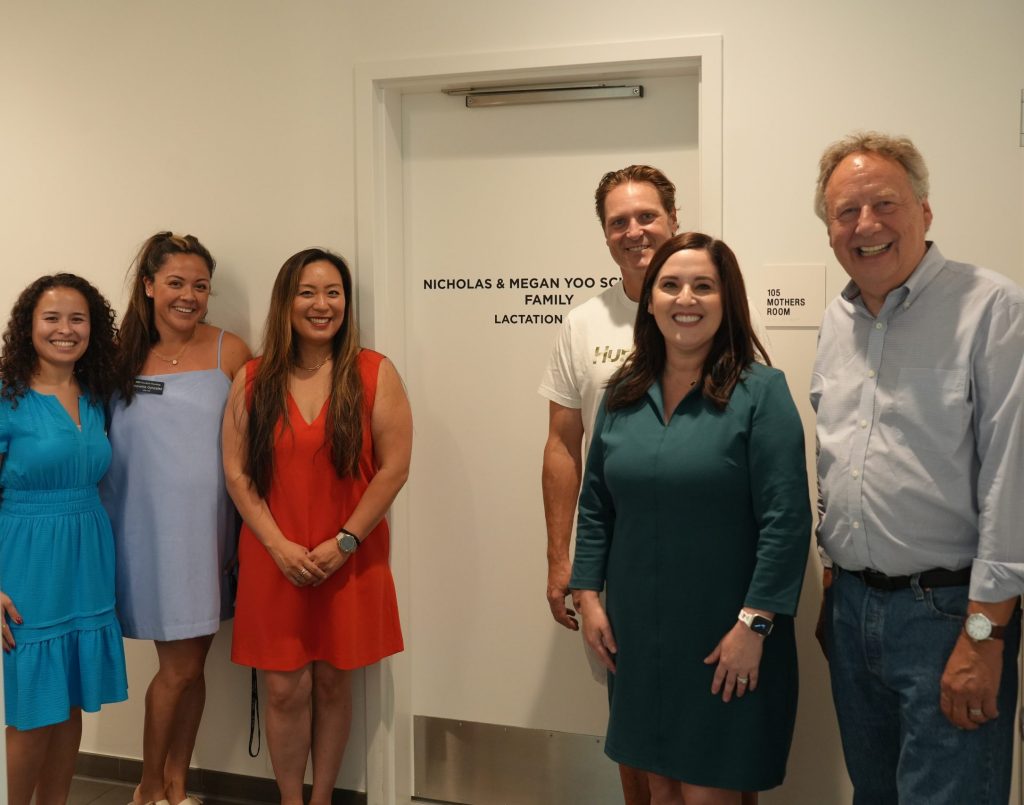
What inspired you to give back to UC Irvine by naming the lactation room at Verano 8?
Serving on the Dean’s Leadership Council has allowed me to hear so many graduate students share their personal stories. One of the things I appreciate most about UC Irvine is how intentionally it supports students from all backgrounds. It’s not just culturally and ethnically, but also economically and through different life experiences.
My husband, Nicholas and I don’t have children. We’ve been navigating IVF after my cancer journey, and that experience made this opportunity especially meaningful to us.
When people hear “lactation room,” they often think it’s only about supporting mothers. But it’s really about supporting families. Having a dedicated, welcoming space helps parents balance graduate school with raising children, and that’s something that benefits the entire family.
Graduate students aren’t just researchers or scholars. Many are also spouses, caregivers and parents. When we support those parts of their lives, we’re helping them succeed academically too.
Why is supporting graduate student families so important to you?
When I was earning my master’s degree, many of my classmates were doctoral students. One friend had young children and was pursuing his Ph.D. when his wife was diagnosed with breast cancer. Ultimately, he had to leave his program to care for his family.
Stories like his have stayed with me.
Graduate school is already incredibly demanding. When you add caregiving responsibilities, financial pressures or unexpected life challenges, the burden becomes even greater.
Today having completed an executive doctorate myself, I’ve watched accomplished CEOs and senior executives struggle through the dissertation process. It reminds me just how mentally and emotionally demanding graduate education can be.
That’s why I believe supporting graduate students means supporting their entire support system. Small resources—whether it’s childcare, family spaces or a lactation room—can make an enormous difference in helping students persist toward their degrees.
What motivated you to join the Graduate Division Dean’s Leadership Council?
I have Professor Goran Matijašević to thank for that.
He taught one of my favorite classes at UC Irvine about entrepreneurship and engineering. What made the course so impactful was that he invited engineers who had become entrepreneurs to share their experiences.
For the first time, I realized that the way I approached problems wasn’t unusual, I simply had an entrepreneurial mindset. Throughout my career, I’ve always asked, “How can we improve this? Is there a better way?” Early on, especially as an Asian woman in a traditionally male-dominated engineering field, I sometimes felt like people wanted me to stop asking questions.
That class helped me understand that curiosity and challenging the status quo could actually be strengths.
Years later, Goran encouraged me to join the Dean’s Leadership Council. I’m incredibly grateful he did because it’s given me another way to stay connected to UC Irvine and support future graduate students.
Your career has included engineering, business, technology, public service and education. What continues to motivate you?
I’ve always believed education has the power to transform lives.
That’s one reason I serve on the advisory board for Breakthrough San Juan Capistrano, which helps first-generation students prepare for college and successfully navigate higher education.
One thing I’ve learned is that getting students into college is only part of the equation. They also need emotional support, mentorship and community to help them thrive once they’re there.
That resonates deeply with my own experience because there were so many moments in my educational journey when mentors and professional networks opened doors that I couldn’t have opened by myself.
What advice would you give graduate students beginning their journey at UC Irvine this fall?
First, you don’t have to have everything figured out right now.
Second, enjoy the journey.
It’s so easy to become focused on the destination that you forget to appreciate the people, experiences and opportunities along the way. The friendships you build, the mentors you meet and the memories you make at UC Irvine will stay with you long after you’ve earned your degree.
You’ll get where you’re going. Don’t forget to enjoy the process, not just the outcome.
Looking ahead, what do you hope UC Irvine continues to do for graduate students?
I hope UC Irvine continues doing exactly what it does so well, which is seeing students as whole people.
Graduate students aren’t defined only by their research. They’re members of families, communities and workplaces. When universities recognize all of those dimensions, students are better equipped to succeed.
I also hope higher education continues to emphasize the lifelong value of learning. A degree doesn’t teach you every answer you’ll need in your career. What it does teach is how to think critically, solve complex problems, communicate effectively and continue learning throughout your life.
Those are the skills that remain valuable no matter where your career takes you, and they’re exactly what UC Irvine continues to cultivate.