

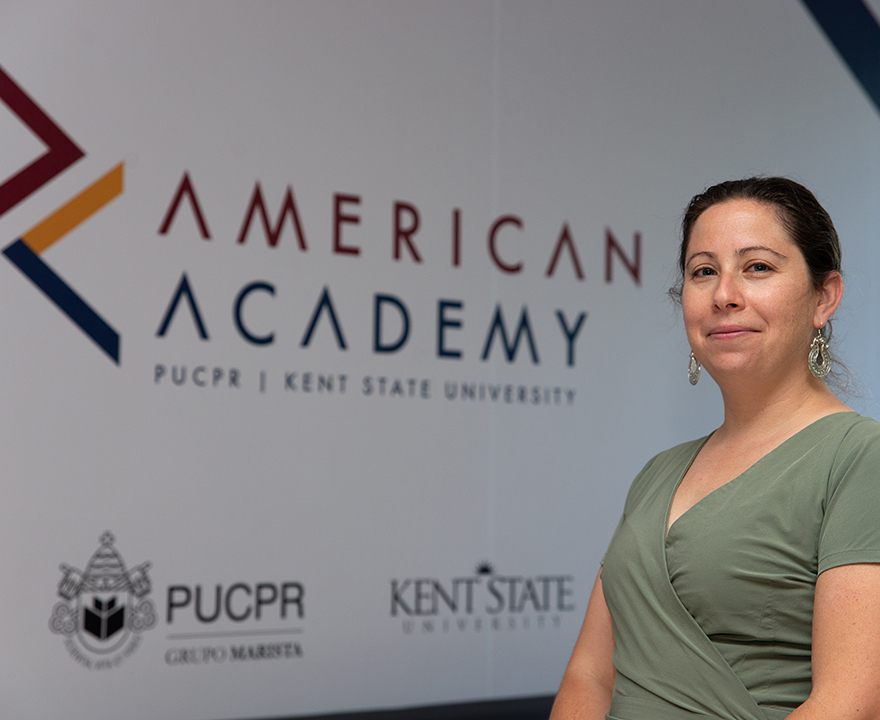
Jill Kato for UC Irvine School of Social Sciences
Most people would do almost anything to avoid standing in the middle of a room where 90 people are shouting at each other. For Johanna Solomon, this is an environment that feels, if not comfortable, then deeply purposeful.
“I was born to be in the middle of that level of chaos,” she says, laughing at the realization.
For Solomon, who earned her Ph.D. at UC Irvine in political science in 2015 and who is now an assistant professor at Kent State University in the School of Peace and Conflict Studies, conflict has never been something to avoid. It is a place where people confront their own assumptions and sometimes change their minds. Across a career devoted to dialogue, mediation and peace building, Solomon has built her work around the central belief that lasting solutions only emerge when people are willing to listen across difference.
The making of a peace builder
That instinct began long before she arrived at UC Irvine. Growing up in New Hope, Pennsylvania, Solomon lived in what she describes as a loud Jewish household where debate was a form of connection rather than tension.
“Debate is baked into how you are supposed to learn,” she says. “Questioning ideas and defending your perspective are part of how people engage with one another.”
Listening closely to opposing perspectives became second nature. So did trying to find common ground. Some of that instinct was nurtured by the culture she grew up in. Some of it, Solomon suspects, was simply innate.
She describes herself as a natural collaborator. “I really enjoy listening to different perspectives,” she says.
Solomon traces many of her earliest ideas about justice and responsibility back to her grandmother, who lived with her family while she was growing up. Her grandmother was a nurse with a master’s degree at a time when few women held advanced degrees and later directed a nursing school in New York during the civil rights era. At one point, she was instructed to admit only white women into the program.
“She just said no,” Solomon says.
The story became foundational to Solomon’s understanding of power, responsibility and moral courage.
“She instilled this idea of using your privilege and power to make sure that other people had equal access and had an equal chance,” Solomon says.
As an undergraduate, Solomon initially planned to pursue psychiatry. At the University of Chicago, she studied comparative human development, an interdisciplinary program blending anthropology, psychology, biology and political theory. She became fascinated by how humans organize themselves into groups and how systems of power shape identity and behavior. At the time, she worked with youth with gang involvement in an alternative behavioral school with self-harm or psycho-affective challenges.
After earning her undergraduate degree, Solomon attended Northwestern University, where she completed a master’s degree in counseling psychology specializing in children and adolescents. During that program she worked at an inpatient alternative placement for youth navigating mental health challenges, addiction and frequent court involvement. Many had gang ties. The experience deepened her understanding of how social structures shape the choices available to people.
“I came to really admire the kids I worked with and realize how smart they were, and how deeply society and power shaped the choices they believed were available to them,” she says.
The work also revealed something else. She enjoyed facilitating groups more than working one-on-one. She found herself drawn not only to individual healing but to the dynamics between communities.
Discovering dialogue at UC Irvine
At UC Irvine, Solomon found a program flexible enough to hold an interest not contained by a single discipline. The Ph.D. program in political science, ranked among the top 20 at public universities, offered the intellectual range for her to pursue psychology as well. She also found a place where her interests in power and identity converged. The Center for Citizen Peacebuilding brought faculty, students and community members together. It supported programs for citizen peacebuilding, including student researchers like Solomon. There she was able to experience the community and mentorship of the other board members
The center also supported a pioneering experiential learning program that brought together Jewish, Muslim, Arab and other students to study the Israeli-Palestinian conflict and travel together throughout the Middle East. Participants, including Solomon, met with community leaders, visited refugee camps and spent countless hours processing difficult conversations as a group.
At first, Solomon approached dialogue work skeptically. She thought it had some promise, but she had some doubts as to whether it would really work. Over time, that skepticism faded.
“The more intergroup dialogue organizations I got to meet and learn about, the more I became convinced that it is the only thing that works,” she says.
Her dissertation research focused on dialogue and identity formation, using experiences from both UCI and the Los Angeles-based Muslim-Jewish organization New Ground as case studies. She examined how people from deeply different backgrounds navigate difficult conversations without erasing disagreement.
“I need to hear all these perspectives in order to solve these problems,” Solomon says. “You can’t pressure people into solutions they don’t truly believe in. That only creates stalemate. I believe in long-term solutions.”
That philosophy became central not only to her scholarship, but to the way she approaches teaching, facilitation and leadership.
Mentors who modeled humanity
Solomon speaks about UC Irvine mentors with the kind of affection usually reserved for close family friends.
“Daniel Brunstetter and David Snow were absolutely amazing researchers, but also really genuine, warm, helpful humans,” she says.
She credits them with helping her learn how to write, publish and think critically about difficult topics while also modeling empathy, generosity and intellectual openness.
Brunstetter, in particular, remains an important figure in her life and career. She admired the way he treated graduate students as emerging colleagues rather than passive learners.
“Daniel continues to be a mentor,” Solomon says. “He really sees the humanity in everyone.”
She also points to the influence of professor Paula Garb, who introduced her to mediation work and the Alternatives to Violence Project, which helped shape her path into alternative dispute resolution.
Outside the classroom, Solomon found mentors throughout the broader Center for Citizen Peacebuilding community. Faculty opened their homes, community members hosted students for dinners and conversations, and relationships stretched beyond academic boundaries.
“It was transformative to see that community members cared that much about connecting and humanizing people,” she says.
Those experiences reinforced a lesson Solomon still carries into her own classrooms today, that intellectual work and human care are inseparable.
Beyond stalemate
Now a faculty member at Kent State University, Solomon continues to teach dialogue, mediation and conflict resolution while facilitating community-based initiatives across political, religious and cultural divides.
Her work often begins with practical, everyday concerns rather than sweeping ideological debates. In Akron’s North Hill neighborhood, one community dialogue project revealed tensions among longtime residents and newly arrived refugee populations. Solomon initially expected conversations to focus on crime or cultural conflict. Instead, residents discovered a surprisingly universal frustration.
Potholes.
Not ordinary potholes, but massive craters nearly three feet deep. They had become a source of tension in the neighborhood, with residents from different cultural backgrounds responding in different ways — driving on sidewalks, veering into opposite lanes or avoiding roads altogether. Through facilitated dialogue, residents realized they shared the same problem. And together, they organized and pushed local officials to fix it.
Another breakthrough came through food. During one session, an older white restaurant owner who had spoken critically about immigrant communities spent lunch eating churros and Nepali food prepared by immigrant-owned businesses. By the end of the event, he was offering to help those same business owners navigate local regulations and paperwork. For Solomon, moments like those reveal the power of humanization.
That work feels especially urgent in a deeply polarized political climate. Although she is invested in brokering conversations, Solomon does not romanticize it or mistake it for an instant solution. She speaks candidly about her fears regarding political extremism, democratic erosion and increasing social fragmentation. Still, she finds hope in smaller moments, especially in the classroom.
“People actually care about a lot of the same things,” she says. “They may just listen to different sources of media.”
She does not pretend dialogue can solve everything. But after years spent studying identity, mediation and conflict, she remains convinced that long-term solutions require people to stay in the room with one another.
After all, Solomon has always been drawn to the middle of the conversation. Not because conflict is comfortable, but because it is where people learn, challenge one another and sometimes change. For Johanna Solomon, that possibility is always worth staying for.